Author: Heidi Hartman
MS Learning and Organizational Change, Northwestern
Course: 421 – Advancing Learning and Performance
Year: Fall 2014
Overview
Theriou, Maditinos & Theriou (2001) explain that organizations can improve their effectiveness when new information technologies are successfully adopted within teams and organizations. Unfortunately implementing new technologies within teams disrupts existing routines and relationships, requiring potential users to re-learn how to work together (Edmondson, 2003). If the implementation of new technology is not managed well, these disruptions could diminish a team’s performance.
This article examines the challenges of introducing new technology within developed teams, the role of the team leader in the technology implementation process, and provides recommendations for leaders to minimize the disruptions of the new technology.
Importance to the MSLOC Community
Cabrera, Collins, & Salgado (2006) reported that information technology has made it possible for the “interconnection of employees” and information exchange across time and distance. The MSLOC program is an example of this.
The MSLOC community will inevitably face new technologies whether in work teams or within MSLOC teams and would benefit from having a better understanding of potential challenges and recommendations when implementing technology within a team.
Problem Analysis
New Technology Disruptions in Teams
Adopting new technologies is a challenge that usually proves more difficult than initially anticipated and can trigger changes in team routines (Edmondson, Bohmer, & Pisano, 2001). Established team routines are assumed effective because they have been well honed over time (Garfield & Dennis, 2012). These established routines reinforce a cycle of stability that can provide a source of resistance in the adoption of new technologies (Edmondson et al., 2001).
In addition to changing daily routines, the implementation of new technologies may create conflicts or misalignments with team structures and norms (Edmondson et al., 2001; Susman, Gray, Perry, & Blair, 2003). (See Figure 1)

As referred to by Susman et al. (2003), when the technology does not align with the expectations of teams or team members, it can create conflicts that could limit the successful implementation of the new technology and potentially diminish a team’s performance. If technology is changed without any complementary changes in tasks, team structure and norms, then the potential exists for additional misalignments and disruptions (Susman et al., 2003).
The implementation of new technology will require people to not just learn how the technology works, but to begin to envision, coordinate and communicate how the technology may transform how the work is done (Edmondson, 2003; Edmondson et al., 2001). This is where the role of the leader is essential. Many researchers explain that leadership is one of the essential factors that influence the success of information technology adoption. (Anantatmula, 2008; Kuo, Ming-Fong, & Lee, 2011; Peng & Mu, 2011; Quaddus & Xu, 2005; Theriou, Maditinos, & Theriou, 2011; von Krogh, Nonaka, & Rechsteiner, 2012).
Role of Team Leader in Implementing New Technology
There is complexity, newness, time and budget constraints, uncertainty, and demanding expectations during the implementation stage of information technology. As a result leadership takes on greater importance during this stage (Anantatmula, 2008).
Edmondson et al. (2001) suggests leaders frame the new technology implementation within a collective learning process. Figure 2 below shows the relationship of the leader in the collective learning process.
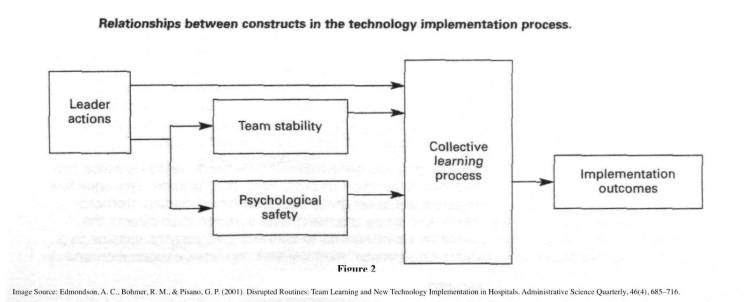
According to Edmondson et al. (2001) team leaders play a key role in leading the change to a new technology by directly contributing to the building of excitement and courage through genuine and authentic invitations for change. If people perceive that their leaders and co-workers value the new technology, they are more inclined to engage in new behaviors (Cabrera et al., 2006). Edmondson et al. (2001), also suggest that team members may defer to team leaders to take the first step toward initiating new behaviors.
Solutions and Best Practices for Team Leaders
Below are recommendations for team leaders to consider to successfully implement new technology (leaderless teams should consider appointing someone as a Technology Lead to execute on these recommendations).
- Frame the adoption of the new technology as a team innovation and learning project rather than a plug-in component (Edmondson et al., 2001). See Figure 3 (below) of a four-step process model for establishing new technological routines where part of the first step is to set the frame as a team learning project.
- Serve as a role model. As von Krogh (2012) suggests, role modeling may enhance employee’s motivation. This could also be referred to as ‘leading by example’ (Bryant, 2003).
- Identify clear benefits for team members to motivate them to integrate the technology as part of their daily routine (Quaddus & Xu, 2005).
- Create psychological safety by (1) communicating clearly and effectively to establish an environment of openness and transparency (Anantatmula, 2008) and (2) creating trainings and learning opportunities for practice (Edmondson et al., 2001).
- And as in many learning processes, experiment and take time to reflect until the new technology/routine becomes accepted and established (Edmondson et al., 2001).

Conclusion
The introduction of new technology within teams will lead to a change in team norms and routines. During the implementation stage, a team will face complexity and uncertainty and will rely on team leadership for direction, clarity, coordination, and communication. As suggested by Edmondson et al. (2001), team leaders should frame the technology implementation as a team-learning project rather than as a simple plug-in component and follow the four-step process model for establishing new technological routines.
References
Anantatmula, V. S. (2008). Leadership role in making effective use of KM. VINE, 38(4), 445–460.
Bryant, S. E. (2003). The role of transformational and transactional leadership in creating, sharing and exploiting organizational knowledge. Journal of Leadership & Organizational Studies, 9(4), 32.
Cabrera, Á., Collins, W. C., & Salgado, J. F. (2006). Determinants of individual engagement in knowledge sharing. International Journal of Human Resource Management, 17(2), 245–264.
Edmondson, A. C. (2003). Framing for learning: Lessons in successful technology implementation. California Management Review, 45(2), 34–54.
Edmondson, A. C., Bohmer, R. M., & Pisano, G. P. (2001). Disrupted Routines: Team Learning and New Technology Implementation in Hospitals. Administrative Science Quarterly, 46(4), 685–716.
Garfield, M. J., & Dennis, A. R. (2012). Toward an integrated model of group development: Disruption of routines by technology-induced change. Journal of Management Information Systems, 29(3), 43–86.
Kuo, R.-Z., Ming-Fong, L., & Lee, G.-G. (2011). The impact of empowering leadership for KMS adoption. Management Decision, 49(7), 1120–1140.
Peng, G., & Mu, J. (2011). Technology adoption in online social networks. Journal of Product Innovation Management, 28(s1), 133–145. doi:10.1111/j.1540-5885.2011.00866.x
Quaddus, M., & Xu, J. (2005). Adoption and diffusion of knowledge management systems: field studies of factors and variables. Knowledge-Based Systems, 18(2–3), 107–115.
Susman, G. I., Gray, B. L., Perry, J., & Blair, C. E. (2003). Recognition and reconciliation of differences in interpretation of misalignments when collaborative technologies are introduced into new product development teams. Journal of Engineering and Technology Management, 20(1–2), 141–159. doi:10.1016/S0923-4748(03)00008-0
Theriou, N., Maditinos, D., & Theriou, G. (2011). Knowledge management enabler factors and firm performance: an empirical research of the Greek medium and large firms. European Research Studies, 14(2), 97+.
Von Krogh, G., Nonaka, I., & Rechsteiner, L. (2012). Leadership in organizational knowledge creation: A review and framework. Journal of Management Studies, 49(1), 240–277.
 Heidi Hartman